



How is finding a technology partner similar to shopping on a busy Agra street? To understand this, let me take you to the streets of Agra.
Now, imagine walking on the crowded Agra street with many street vendors trying to grab your attention. All of them are attempting to sell the same “Taj Mahal” – well, more or less the same-looking Taj Mahal. You want to buy one, but you are utterly confused about who you should buy it from. All of them look the same, and by thin margins, all of them speak of the same attributes – white marble, good craftsmanship, and nicely packed.
Now, how will you decide who to buy from?
The Technology Partner Dilemma
When you go out finding a technology partner, the experience is like walking through Agra Street. It will differ if you work in niche technologies where your options are limited. Pick a mainstream technology like .NET, spread the word about your need, and you will likely receive at least 50 proposals in your inbox within a day. And all of them will have similar technology capabilities.
How Do You Decide Who Is the Right Technology Partner?
Isn’t it like dating? When you have a bunch of similar profiles, how do you decide which one is right for you? You need some criteria in the generalist world. Here is a recommended three-step method for finding the right technology partner. This approach works for small, medium, or large-sized businesses.
No – it wouldn’t work for dating… to be honest, I never tried!
Step 1: The Hygiene Test

Yes, you are neck-deep in work and dealing with competition. When you look for technology partners, you pretty much know what you want and what you don’t want. The key is to identify which of the parameters are Hygiene factors. Hygiene factors are those which, when absent, are felt the most, and when present, are ignored the most. Let me put my hygiene parameters in their order of importance.
What are your hygiene factors?
- Value Proposition: Value delivered per unit of cost spent. Fundamental in nature but not “the” only factor.
- Attitude of the Partner: Incorrect attitude that doesn’t align with the customer-first philosophy will take the relationship nowhere.
- Communication: Lack of, unclear, or reactive communication will cost and ruin the project – and eventually the relationship too.
These are the most essential hygiene factors that will matter the most when choosing a technology partner. The absence of either of these parameters will create havoc. The presence of all these will not even make you blink an eye! You will feel things are as they are supposed to be.
Step 2: Check Credibility
After the hygiene factors are met, the next parameter to consider is Credibility. Let’s say you are looking for a partner with experience in Azure Cognitive Services. Assume that you couldn’t find a close match but have a list of 3 probable partners. Now, who you would choose will depend more on the credibility the partner carries.
Why does credibility matter so much?
Credibility is not just the availability of skills but proven execution capability. It is the ability to service customers and build stronger relationships. Credibility is excellence achieved through consistent at-par deliveries. Just the availability of relevant skills doesn’t ensure delivery – credibility does.
Step 3: Availability of Relevant Skills
The least important while choosing a partner is the availability of relevant skills. Yes, truly it matters the least if Step 1 and Step 2 are met. Funny enough – we all start with relevant skill as the first parameter to evaluate, don’t we?
In the commodity market, skills can be learned quickly. With the right partner in place that has hygiene factors addressed (Step 1) and credibility accumulated (Step 2), acquisition of skills is a matter of time. This time taken to acquire skill could be less than evaluating and finding another partner that has relevant skills.
Visualization of Partner Evaluation

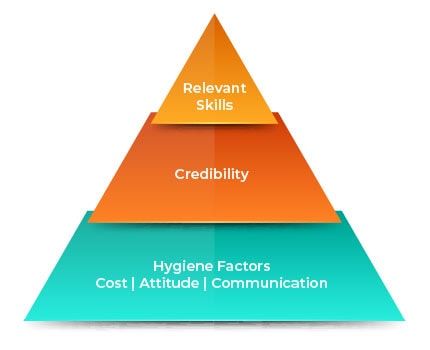
I have seen the above formula working for many years through the successful partnerships that I have built. I have seen it working in my earlier company – Cybage too. Hygiene factors are the true foundation of the partnership pyramid. These are basic and essential. Credibility makes the partnership even stronger.
Hygiene factors are a sword. Credibility is the edge of the sword. Relevant skills are the sharpening of that sword.
What takes more time – making a sword or sharpening it?
Let’s hit the ground running. I apply these steps when I work with partners. It helped me extensively. What are your experiences?
