



Before delving into state management, it is essential to understand what state is.
What is State?
State is a term commonly used in mobile or web application development. But how would you define it?
Imagine you are drinking tea. Your current state is that you are drinking tea. We could narrow it down further — you might be holding the tea mug and lifting it to your mouth. Thus, your state is that you are holding the mug and lifting it up while your mouth is open.
So, state is not just a single thing. A person can be in multiple states simultaneously, depending on how you look at it. In programming, it is similar. We can define state as the behavior of an application at a given moment in time.
What is State Management?
State management is crucial whether you are building a mobile app or a web application. It refers to the management of the state of one or more UI controls. These UI controls can be:
- Text fields
- Radio buttons
- Checkboxes
- Dropdowns
- Toggles
- Forms
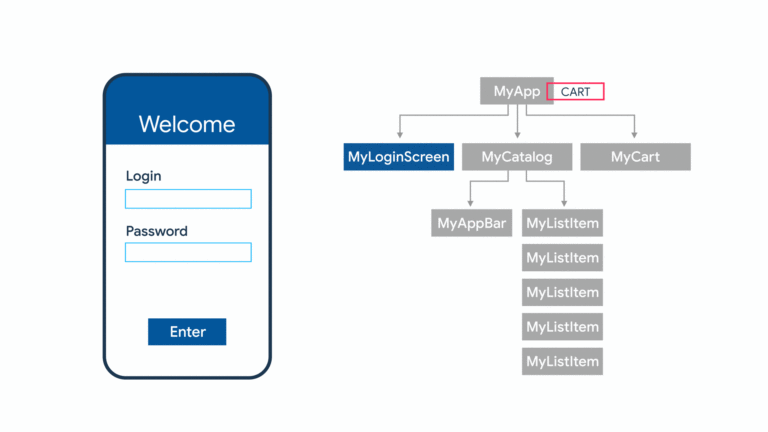
A website or web application comprises numerous UI controls, and the state of one UI control often depends on the state of others. Every framework has its unique way to manage these states.
State management centralizes all the states of various UI controls to handle data flow across the application effectively. It can be managed on both the frontend and backend.
Benefits of State Management
- Reduces HTTP Requests: Whenever a user refreshes the browser, if data changes or new data is added, a request will be sent to the server. This reduces the number of HTTP requests sent to the backend.
- Centralized Application State: All application states are maintained at a single location, simplifying access and management.
- Data Synchronization: Server data can be easily updated or refreshed, ensuring data consistency.
- Code Simplification: State management helps centralize code, reducing code size and improving readability. This, in turn, simplifies maintenance and enhances code quality.
Now that you’re aware of the benefits, let’s explore some state management techniques for mobile application development.
State Management Techniques for Mobile Application Development (Flutter)
- Scoped Model
- Provider
- SetState
- InheritedWidget & InheritedModel
- Redux
- Fish-Redux
- BloC/Rx
- GetIt
- MobX
- Getx
- RiverPod
State management is essentially a design pattern aimed at effectively sharing state data across components while separating domain representation from state management. This pattern is widely applied in many popular web frameworks such as NGRX, Vuex, Redux, or Flux.
Conclusion
State management is especially important when you are dealing with large scale applications, where it plays a major role in optimizing performance and enhancing usability of the solution.
